Dinsdag 14 Mei 2013

Yamaha's Ben Spies stuns with pole position on World Superbike debut


February 28, 2009 The 2009 World Superbikes season is off to a cracking start, with an action-packed qualifying stage and Superpole now decided. Boasting a huge grid of superstar riders, some ominous new faces, a raft of new bikes and brand new teams from BMW and Aprilia, we've tipped WSBK 2009 as the one to watch over MotoGP in our detailed season preview a few weeks ago. And what a start! Texan Ben Spies has taken an astonishing Superpole victory on his international debut for Yamaha, ahead of veteran Max Biaggi on the brand new Aprilia RSV4 and newcomer Jonny Rea on his Hannspree Honda CBR1000RR. The new Superpole format has proven itself to be pure cut-throat desperation and a great spectacle - and the races tomorrow should be absolutely stunning. A crack team of Gizmag bike-heads reports from Australia's Phillip Island GP circuit.

Ben Spies, fresh from humbling the previously untouchable Mat Mladin by taking the last three AMA Superbike championships in America, has sent the World Superbike paddock a sharp warning by taking a stunning pole position this afternoon at Phillip Island in his international debut.
To put his achievement in perspective, Spies has never ridden at Australia's storied Phillip Island racetrack before; he's had precious few sessions on track to learn which way the track goes, master it and then post a staggering 1'31.069 lap time well under 2008 champion Troy Bayliss's previous lap record.
Perhaps even more amazing is 'Roman Emperor' Max Biaggi's second position on grid. Biaggi, multiple world 250cc GP champion and a famous rival to Valentino Rossi in MotoGP, has had only a handful of tests to develop his Aprilia RSV4, a brand new bike and engine that has been put together for the 2009 SBK series. For the Aprilia to qualify faster than any Ducati, Honda or Suzuki in its debut race meeting is astonishing.
The other new bike on the grid, the BMW S1000RR, didn't fare so well. 2005 WSBK champion Troy Corser made a critical tyre choice mistake in the new Superpole qualifying session and was relegated to 17th position after finishing with a top-5 time in early qualifying rounds.

The new Superpole format shines

The new Superpole format will be an event in itself for 2009 - the sudden-death knockout format sees the top 20 riders from qualifying go out for 12 minutes, after which the top 16 are let through for another 12 minutes, and then half are eliminated before the final eight fight for pole position and the front two rows of grid positions.
The nail-biting new format bit a couple of expected front-runners as Haga and Neukirchner bowed out in the second session - but Troy Corser's Team BMW must be kicking themselves for assuming that they'd make the final eight on race tyres, preserving his qualifiers for the final session. A flurry of surprising quick laps from riders like Leon Haslam, Regis Laconi, Jakub Smrz and Carlos Checa relegated Corser to a disastrous 17th on the grid.

Tomorrow's Races

Ben Spies' dominant performance in Superpole comes on the back of consistently fast times throughout the weekend - and he's got a proven ability to thrive in the most heated and desperate race conditions. We'd have to say he's looking like a strong chance to take at least one victory in tomorrow's races.
Other consistent front-runners have included Hannspree Honda's Jonny Rea, who looked almost certain to take Superpole until Spies and Biaggi pulled scorching laps out of the bag in the final session. This is Rea's first look at Phillip Island as well - the BSB-bred youngster is looking fast, confident and very dangerous this weekend.

Biaggi's Aprilia has had the odd reliability issue, and Nitro Nori Haga is starting from a difficult 13th place, which might take either or both of them out of contention for a win. Still, it's a fool who would bet against either of these fierce and experienced competitors. Ducati riders Jakub Smrz and Michel Fabrizio have been strong throughout - and Regis Laconi posted a jaw-dropping time in the second session of Superpole, but none have been hugely consistent yet and Smrz in particular hasn't shown himself to be a contender on race days in the past.

Shakey Byrne has struggled to come to grips with the Phillip Island circuit, rarely troubling the top 10 in qualifying times - but he's a phenomenal rider and is bound to feature through the series, whether or not he makes an impact tomorrow.

Weather conditions at Phillip Island are notoriously variable, so we won't know until the last minute what to expect tomorrow - but one thing's for sure, our eyes will be glued to the track for some excellent racing - if the Gizmag team manages to avoid severe overindulgence at any number of Superbike weekend parties tonight! Wish us luck... Incremental updates as they happen over at TheBikerGene.

Final grid positions:

  • 1. Ben Spies USA Yamaha Italia YZF R1 1min 31.069s
  • 2. Max Biaggi ITA Aprilia Racing RSV-4 1min 31.402s
  • 3. Jonathan Rea GBR HANNspree Ten Kate Honda CBR1000RR 1min 31.596s
  • 4. Jakub Smrz CZE Guandalini Racing Ducati 1098R 1min 31.600s
  • 5. Michel Fabrizio ITA Ducati Xerox 1098R 1min 31.837s
  • 6. Leon Haslam GBR Stiggy Motorsport Honda CBR1000RR 1min 32.112s
  • 7. Carlos Checa ESP HANNspree Ten Kate Honda CBR1000RR 1min 32.537s
  • 8. Regis Laconi FRA DFX Corse Ducati 1098R 1min 32.649s
  • 9. Shinya Nakano JPN Aprilia Racing RSV-4 1min 31.843s
  • 10. Ryuichi Kiyonari JPN Ten Kate Honda CBR1000RR 1min 31.860s
  • 11. Yukio Kagayama JPN Alstare Suzuki GSX-R 1000K9 1min 31.867s
  • 12. Tom Sykes GBR Yamaha Italia YZF R1 1min 31.881s
  • 13. Noriyuki Haga JPN Ducati Xerox 1098R 1min 31.907s
  • 14. Max Neukirchner GER Alstare Suzuki GSX-R 1000K9 1min 31.916s
  • 15. Shane Byrne GBR Sterilgarda Ducati 1098R 1min 32.119s
  • 16. Broc Parkes AUS Kawasaki SRT ZX-0R 1min 32.719s
  • 17. Troy Corser AUS BMW Motorrad S1000RR 1min 32.873s
  • 19. Roberto Rolfo ITA Stiggy Motorsport Honda CBR1000RR 1min 32.997s
  • 19. Ruben Xaus ESP BMW Motorrad S1000RR 1min 33.152s
  • 20. Tommy Hill GBR HANNspree Althea Honda CBR1000RR 1min 33.363s
  • Following grid positions decided by Qualifying 2
  • 21. Brendan Roberts AUS Guandalini Racing Ducati 1098R 1min 33.588s
  • 22. Makoto Tamada JPN Kawasaki SRT ZX-10R 1min 33.709s
  • 23. Ayrton Badovini ITA PSG-1 Kawasaki ZX-10R 1min 34.174s
  • 24. David Salom ESP Team Pedercini Kawasaki ZX-10R 1min 34.194s
  • 25. Karl Muggeridge AUS Celani Suzuki GSX-R1000 1min 34.341s
  • 26. Luca Scassa ITA Team Pedercini Kawasaki ZX-10R 1min 34.390s
  • 27. Vittorio Iannuzzo ITA SCI Honda CBR1000RR 1mins 35.767s
  • 28. Matteo Baiocco ITA PSG-1 Kawasaki ZX-10R 1min 36.363s
Source: gizmag.com @By Loz Blain

Donderdag 09 Mei 2013

Suzuki joins big-bore enduro market with RMX450Z


Suzuki is finally joining the serious off-road marketplace with an all-new fuel-injected RMX450Z enduro racer. The bike is based on Suzuki's RM-Z450 motocrosser, with a significantly-reworked version of the Electronic Fuel Injection (EFI), 449cc, DOHC, four-valve, liquid-cooled, single-cylinder engine. A longer inlet tract, less radical cam profiles, wider gear ratios plus an electric starter are the main changes to the high-spec off-road weapon, all wrapped in the motocrosser's frame, suspension and bodywork.
 
Delivering exceptional power and torque, the RMX450Z uses an Electronic Fuel Injection (EFI) system to ensure smooth, crisp and strong power delivery, lower emissions and impressive fuel economy, which is just as well, because they've left the bike with the same tank as the motocross machine – a serious oversight that will mean a lot of aftermarket gas tanks get sold for the otherwise ideal off-road competition machine.

Suzuki pioneered fuel-injection for motocrossers, and the RMX450Z shares all key technologies with the RM-Z450 using the same Keihin throttle body with progressive linkage. Fuel-injection also enables the RMX450Z to be "green sticker" eligible in the state of California. This advanced fuel-injection system also eliminates the need for re-jetting at higher elevations.

A modified inlet tract and revised cam profiles enhance low and mid-range power, while the airbox features a hinged lid for quick air filter access, easier maintenance and better dust protection. To meet the demands of trail riding, the RMX450Z has an extra coolant reservoir tank and relocated filler cap, along with a bash plate. Wider primary and final drive ratios in the five-speed transmission help riders get the most from the engine.

Kick-starting a big single with a high seat can be a heartbreaking experience on the trail so we're pleased to see the RMX450Z features an electric starter, while the starter and lights' centrally-located batteries are charged by a larger magneto-generator.

Based on the RM-Z450 but optimized for off-road riding, an aluminum alloy frame utilizes cast and extruded sections in a slim, lightweight, rigid and tough package.

The RMX450Z features a Showa suspension package derived from the championship winning RM-Z450 - the 47mm inverted front forks are fully adjustable for rebound and compression settings, while the rear shock unit offers fully adjustable rebound, compression and pre-load settings.

Spring rates and suspension geometry on the Suzuki have been developed for off-road riding, combining with an 18 inch rear wheel to offer razor-sharp cornering and a smooth ride across rugged terrain.

Slim bodywork, a low-profile aluminum fuel tank and a motocross-developed seat gives RMX450Z pilots a functional riding position to focus on the terrain ahead to optimize line selection.

The RMX450Z's compact instrumentation offers riders the choice between two modes, a sports mode showing the basic information a rider needs in competition, such as a trip meter, timer and average speed, while a standard mode displays additional information including speed, time and information of two trip lengths.

Source: gizmag.com @By Gizmag Team
 

Sondag 05 Mei 2013

The GG Quadster - a four-wheeled, 167-horsepower quad bike for the road


Since the emergence of non-tilting 3-wheelers like the bizarre snowmobile-for-the-road Can-Am Spyder, and the abundance of attention they've received, this new class of novelty multi-wheelers seems to be gathering steam. The latest we've run across, thanks to a Gizmag reader suggestion, is the GG Quadster. This Swiss creation takes the 167-horsepower motor and electrics from a BMW K1200 sportsbike and puts it in a 4-wheeled chassis with sticky sports tyres and more machined billet aluminium than comes out of OCC in a whole week. At US$65,000, or around US$40k more than the Can-Am Spyder, you'll rarely see one on the road. But if you do, and there's a really tall black guy riding it, you might want to catch him for an autograph.
 
GG stands for Gruter und Gut, the fabrication shop that brought us the GG quad a few years back. That odd-looking contraption used the 100-horsepower BMW boxer twin motor and stuck it in a similar, F1-style race car chassis, and it proved popular enough for GG to move on and bring us the Quadster - a similar machine, but with a generous dollop of extra power thanks to its sportier inline 4 cylinder K1200 motor.

That motor uses its normal BMW gearbox, with similar gearing, but with the addition of a reverse gear, which can be engaged by flicking a safety switch and then pressing firmly on the rear brake pedal. A handy touch, since vehicles of this kind are almost as hard to push around as a small car.

Speaking of small cars, the Quadster's road footprint is actually slightly longer AND wider than that of a Smart car. But then, Smart cars aren't designed to pull over 1G of sideways acceleration in the corners, nor do they have to deal with a high-revving sportsbike engine. Well, most of the time, anyway.

Each of the Quadster's 4 wheels is shod with wide, sticky Dunlop Sportmaxx tyres, and suspended with a quality Wilbers shock, adjustable for preload and rebound. The brakes are reportedly absolutely massive, with the front lever operating a set of four-piston stoppers on the 270mm discs at the front, and the foot lever operating another two calipers at the front as well as a 30% load through two more calipers at the rear wheels. Stomp to stop, then.

The gearing is tall, as befits its 180mph donor sportsbike, but many testers have found it too tall for a heavier, street four wheeler like this one, which is only rated up to 130mph anyway. Once the clutch hooks up and the revs start building, though, hang on! The Quadster is said to be able to rocket to 60mph in 3.5 seconds.

And here we get to the handling. When Gizmag editor Noel McKeegan rode the Can-Am Spyder, he gave it a generally positive review. I'm not sure I'd be so generous. When you're presented with a machine that has a high-revving performance engine and eyeball-popping brakes, you expect it to be a demon in the corners too.

But I found that the Spyder was a real handful in the corners - and I'd go so far as to assume that the Quadster would have a very similar feel. Non-tilting multi-wheel motorcycles have the uncomfortable effect of wanting to throw the rider way out to the outside of the corner. In order to get them around corners at the sorts of speeds that you'd use on a sportsbike, you've got to lunge for the inside of the corner before you make your steering input, which is to pull the inside bar towards you - as opposed to the push you'd normally use to countersteer a bike.

So your outside arm, which has to operate the throttle, if it's a left-hander - can end up quite far away from you, and the inside wheel can start to lift off the ground. It's a very physical style of vehicle to ride, and the dynamics don't make it easy to relax and flow fast through a set of corners. It's a real core-muscle workout, throwing these things about - imagine trying to hook a regular quadbike into a bend at 70mph. Exhilarating, certainly, but a fair fitness challenge if you want to keep up with your buddy who's strapped into the sports seats of his Lotus Elise through the corners.

It would certainly be interesting to see how these machines perform on a racetrack - putting them up against cars and motorcycles to see how they go in terms of lap times, rider safety and fun factor.

Dubious cornering performance aside, the Quadster avoids one serious annoyance a petrolhead would find with the Spyder - it doesn't have a stability control system, so you're free to spin the rear wheels up and get sideways if you're feeling feisty and you're able to break the grip of those two massive rear hoops.
Because there's still so few of these types of vehicles on the road, they're still a guaranteed head-turner. The Quadster can be licensed in Germany as a 4-wheeled motorbike, and it seems registration is somehow possible in America, too.

At US$65,000, the GG Quadster is horrifically expensive if you compare it to a 3.5-second motorcycle, or exceptionally cheap if you compare it to a 3.5-second car. It's just about right if you compare it to high-end custom motorcycles and take in the sheer mass of billet you're getting for your dollar. The list of available options is very impressive for such an odd vehicle, with enormous panniers, alarms, heated grips, limited slip diffs, intercoms, navigation systems and the like all catered for. But you'll want deep pockets to pay for them.
One set of deep pockets that have already been plundered for a GG Quadster belong to the trousers of basketball god and general sports nut Michael Jordan, who already owns a pair of the older GG Quads and has stumped up for the big brother bike.

If Michael ever tires of the Quadster's 167 horses, it's comforting to know that there's a similar machine available that looks a lot nastier and packs about 3 times the power due to its supercharged BMW V12 - that would be French custom cycle shop Lazareth's US$284,000, 500hp Wazuma. Scary.

Source: gizmag.com @By Loz Blain

Dinsdag 30 April 2013

Zero Motorcycles to hit the road in 2010 TTXGP


The running of the first ever clean emissions Grand Prix at the Isle of Man in June made 2009 a landmark year in the history of two-wheeled motorsport. Next year is shaping up to be even bigger. A series of races will be run throughout 2010 beginning with TXGP North America Championship at Infineon in Sonoma, California in May. The latest competitor to throw its hat into the ring is US-based Zero Motorcycles, which will make its road racing debut on home turf with a bike that's expected to be based on the Zero S model.

"It is good news that a company of such standing as Zero is committing to TTXGP 2010, said Jeremy Burne, TTXGP North America Director. "This announcement follows on from last week when Italian manufacturer CRP Racing went public with the news that they will be building a bike, the eCRP1.0, for the TTXGP 2010 series. This kind of initiative on both sides of the Atlantic really positions TTXGP as a truly global player."

Zero tasted success on the dirt in Europe recently with the company's MX model winning the Electric Motorcycle Challenge organized by the French Federation of Motorcycles. Zero finished third overall in points for the series and along the way showed the potential of electric drivetrains by beating some 450cc gas-powered motorcycles. Zero also organized the first all-electric 24-hour endurance motocross race back in April - results of that race can be found here.

According to Zero Motorcycles CEO Gene Banman, the company has identified a series of strategic partners for its tilt at the TTXGP and will announce further details shortly. 


The 2010 TTXGP series will also include three events in the UK (Cadwell Park, Lincolnshire on 3-4 July, Snetterton, Norfolk on 17-18 July and Castle Combe, Wiltshire on 11 September), plus another Isle of Man event in June 2010. A grand final for leading teams will be held in November at an as yet unnamed venue.


Source: gizmag.com @By Noel McKeegan

Donderdag 25 April 2013

Honda aerodynamic scooter conversion results in 214 mpg


Adding a self-built aerodynamic outer shell to a brand new Honda Innova 125i big-wheeled, step through scooter has resulted in its already pretty impressive fuel efficiency being improved considerably. Experienced Dutch cycle designer Allert Jacobs has spent the last couple of years designing, building and tweaking his machine before hitting the road recently for the all important road test.

After designing an aerodynamic, recumbent pedal-powered three-wheeler, Jacobs started to think about the possibility of moving onto bigger and more powerful vehicles. Considering the rules and regulations involved in building a roadworthy car to be too restrictive, he set his sights on a motorbike.
Streamlining performance motorcycles is by no means new. Sport machines began getting some pretty impressive results from enclosed fairings before the Fédération Internationale de Motocyclisme put the brakes on full enclosure fairings for sport motorcycles in the 1950s due to safety concerns.
Since then, work by (amongst others) Craig Vetter has shown that not only does streamlining provide gains in the speed department but also results in some impressive fuel savings. Vetter has, in fact, just recently managed to persuade the Fédération to lift its ban for electric motorbikes, opening the floodgates for electric fairing enhancements for future performance riders.

Aerodynamics is a real drag

Forward movement is of course met with resistance to that movement, from the air and from any surface an object happens to be in contact with. Most of the resistance encountered on a motorcycle however is aerodynamic. Any motorcyclist who has tucked down close to the bike will know that reducing drag results in a speed boost without the need for increased throttle. Jacobs calculated that at 55mph, a naked motorbike is likely to suffer 90% of its resistance due to aerodynamic drag.


 The ideal solution for a fuel efficient motorbike would be an electrically-powered one, but Jacobs considered limited range to be problematic so he opted for the small and light engined Honda Innova 125i, which was first made available to Europeans in 2006 and was intended to replace the popular Super Cub. The Innova is already highly regarded for efficiency, Honda UK claiming it gives: "a robust 46 miles of operation on a single liter of fuel (measured at an operating urban speed of 33mph)".
Filling its 3.7 liter fuel tank got Jacobs around 140 miles to the gallon (mpg) during the initial run in period required for a new vehicle. When he started to increase throttle activity somewhat, the scooter still offered between 107 and 122mpg. Inspired by the work of the likes of Vetter, Jacobs decided to aim for 235mpg fuel efficiency for his creation.

Trimming the fat

In the Winter of 2007 Jacobs started his project by stripping away the Innova's body work and seating. He then installed footrests above the front wheel to cater for a recumbent riding position, threw in some seating and attached a nosecone. An early evaluation showed that even these modest modifications had increased the bike's top speed and fuel efficiency but there was still much more to be done.


As a result of instability issues, he was forced enclose the front wheel within the streamlining casing instead of underneath the nosecone and modify the riding position so that his feet moved down to rest at each side of the wheel when in motion. The latter half of 2008 was spent taking the design suggestions offered by a 1:5 scale model and creating a full size template from PU foam.


2009 dawned and with it the creation of the mould for the final streamlined casing. Modifications were made to the steering and the exhaust was lowered so that it sat outside of the casing. Getting in and out of the casing was made possible by slicing it down the middle and attaching the front end to a rail which extended it forward by 18 inches. Rubber cones and trips ensured a snug fit when in cruising position and an open bottom design catered for stable ground footing when at rest. The lights were also wired up and tested.

Hit the road, Jack

With everything in place and working it was time for the all important road test. Jacobs climbed into the 319 pound vehicle (88 pounds heavier than the original scooter) and set off for a 160 mile stretch of open road. His creation managed to achieve an amazing 214mpg at around 55mph with good conditions and only a 25mph wind.


Jacobs suspects that some fine tuning will see his vehicle reach that target fuel efficiency of 235mpg but as of writing, the poor weather being what it is, he has been putting his time to good use by pimping his ride, adding reflective striping and other embellishments. As the weather improves, his work in progress may yet see his target achieved and perhaps even exceeded.

Source: gizmag.com @By Paul Ridden


Woensdag 24 April 2013

Part dirt bike, part mountain bike, all Mountain Moto


For many people, dirt bikes look fun, but intimidating. They’re dangerously-fast, they’re loud, and should you wipe out on one, which is going to happen... well, that’s a lot of bike that could come crashing down on top of you. If you’re one of these people, you might be interested in the FX Mountain Moto. At 57 kg (125 lbs), it’s billed as the world’s lightest adult-sized dirt bike. It’s intended to bridge the gap between regular dirt bikes and mountain bicycles, combining the power of one with the agility of the other.

The FX has a 125cc 9-horsepower Honda-Jialing engine, available in auto or manual, that gets a reported 100mpg. While it’s mostly a motorcycle, it does have some mountain bike parts, including a Marzocchi Monster fork, a Mavic 26-inch front rim, and a Kenda MTB front tire. It’s similar in some ways to a trials bike, but is designed more for general-purpose, comfortable off-road riding.

One of the main ideas behind the Mountain Moto is that it will allow riders to explore new territory, as it can be lifted (more realistically, let’s say “heaved”) over obstacles like logs and fences, and won’t get bogged down where regular motorbikes would. It’s also aimed at new riders, who aren’t ready for a 200-plus-pound fire-breathing monster. A third market might include vacationers, wildlife officials, or other people who want something light and simple to carry on the back of their road vehicles.

What would be great is if the Mountain Moto were to replace larger bikes in some applications, resulting in less fuel use, less noise, and less wear on the trails. What wouldn't be so great is if it kept people from getting into mountain biking, or encouraged them to ride in places where they don’t belong - such as on mountain bike trails, or private property.
The Mountain Moto can currently only be ordered from the US and Canada, although a dealership network is reportedly being established. Once you can buy one, expect to part with about $US4995. If you’re interested in getting one at a discount, drop by the FX Bikes website and look into becoming a test rider.
Should you wish to go electric, and even lighter, you can also check out the soon-to-be-released Comoto.

Source: gizmag.com @By Ben Coxworth


Sondag 21 April 2013

Students compete to build racing motorcycles from scratch


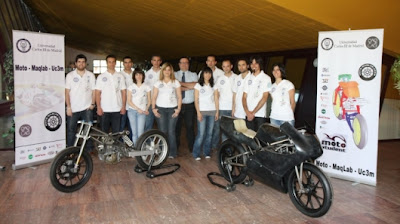
The challenge: to design and build a high speed road-racing motorcycle from scratch, with an eye towards cost-effective production. Could you do it? The folks at Spain’s Universidad Carlos III de Madrid (UC3M) think that a team of their engineering students can. The team is competing in the Moto Student competition, which pits university teams from around Europe and the rest of the world against each other to see who can design the best commercially-viable bike.
The contest is being presented by the Moto Engineering Foundation (MEF). They supplied each team with a 125cc 2-stroke engine, shocks, brakes, tires, wheels and muffler. The teams then designed a prototype around those components, with a hypothetical production run of 500 bikes in mind. One catch: the projected manufacturing cost of those hypothetical bikes cannot not exceed 4,500 Euros (US$5,654) per unit. Teams can swap in components other than those supplied, except for the engine. The bike must be finished within three semesters.
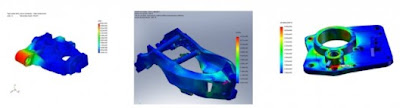
The UC3M team started last year by observing production racing motorcycles, to understand their form and function. That was followed by brainstorming sessions and some initial sketches. Next the students used MEF-supplied 3D design software to create the chassis and swingarm of their bike, assemble everything, and see how it all might work together. Now, they have a real-world physical prototype, which they look forward to testing on the track... presumably their test rider is going to be wearing a lot of protective gear.


 While taking part in the competition is a learning experience for the team, their fresh “outsider” approach could also lead to new insights into motorcycle design. "The main challenge has been to start from scratch, choosing an innovative design, without the constrictions of a traditional approach, with the goal of being able to unify the technical solutions which we think can offer us a competitive edge, and which on the other hand, allow us to learn the most possible," remarked Technical Director José G. Pérez Alonso.
The winner will be chosen at the Ciudad del Motor (Motor City) event in Aragón this October. Top prize is 6,000 Euros (US$7,537).

Source: gizmag.com @By Ben Coxworth